Choose Your Language

Sunday, 28 October 2012

Union Station, Washington, D.C.


Union Station,Washington, D.C.


Annual Visitors: 37,000,000
Opened in 1907, this busy station shuttles some 12,500 passengers daily in and out of the city. But it also handles serious tourist traffic: 37 million who pass through to take in the impeccably mixed architectural styles throughout the colossal building: from Classical to Beaux-Arts to Baroque. More than 70 retail outlets make Union Station a shopping destination, and it’s also a jumping-off point for many D.C. tours. 

Times Square, New York City


 Times SquareNew York City


Annual Visitors: 39,200,000
Tourists flock to New York’s neon heart for the flashing lights, Broadway shows, megastores, and sheer spectacle. Pedestrian-only areas with cafĂ© tables introduced in 2009 have only made it easier and more appealing to hang out here. Times Square can even be a convenient, if chaotic, base, thanks to hotels at every price point and easy access to public transportation: subways, rails, buses, and more yellow taxis than you can count.
Unfortunately, there are no international airlines taking advantage of the 10,500 foot main runway of the the Niagara Falls International Airport. The airport is a low cost alternative to the airports located Toronto Canada and Buffalo-Rochester USA. Currently 3 Low Cost domestic airlines service NFIA. I personally have asked Air Berlin to look into serving NFIA out of Dusseldorf, Germany. This facility has definite international travel potential as does the whole area encompassing Western New York State and the Niagara Peninsula of Ontario. I am not affiliated with the airport. I am simply at 63 year old life long resident who just cannot understand why with all the tourist traffic coming into the city French tourists are flying into Montreal and then traveling by bus for 8 hrs to get here. Or. Indian tourists flying into Toronto, then traveling 2 additional hours by bus to get here.

Wednesday, 24 October 2012

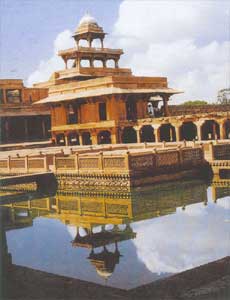
Fatehpur Sikri, Agra


Fatehpur Sikri, Agra 


In honour of saint Shaikh Salim Chishti, the Mughal emperor Akbar, the great, founded a magnificent city on Sikri ridge. In 1571 he ordered the construction of buildings for his own use and asked the noblemen to built houses for themselves. Within a year, most of the work was finished and within the next few years, a well planned city with administrative, residential and religious buildings came into existence.
The Jami Mosque was perhaps among the first buildings to come up. Its epigraph provides AH 979 (AD 1571-1572) as the date of its completion. The Buland ­Darwaza was added some five years later.
Among other important buildings are the tomb of Shaikh Salim Chishti, the Naubat-or-Naqqar Khana (drum-house), Taksal (mint), Karkhanas (royal workshops), Khazana (treasury), Hakim's quarters, Diwan-i-Am (hall of public audience), house of Maryam also called Sunahra Makan (Golden House), palace of Jodha Bai, Birbal's house etc.

Fatehpur Sikri was Akbar's capital for approximately 12 years. Akbar selected Sikri as the seat of his government believing it to be auspicious for himself. He experimented both with architecture and art and built a city expressing his ideals and vision. Today, Fatehpur Sikri is a deserted, phantom city. But the inner citadel is immaculately preserved. The finest monuments within this area are the Diwan-i-Am, Diwan-i-Khas, Panch Mahal, Buland Darwaza and the tomb of Saint Sheikh Salim Chishti, and the Jama Masjid (one of the largest mosques In India).

Timings: 9.00 a.m - 6.00 p.m
Open on all weekdays

Ajanta Caves

Ajanta Caves


The world famous Ajanta Caves including the unfinished ones are thirty in number, of which five (9, 10, 19, 26 and 29) are chaitya-grihas and the rest are viharas (monasteries). After centuries of oblivion, these caves were discovered in AD 1819. They fall into two distinct phases with a break of nearly four centuries between them. All the caves of the earlier phase date between second century BC-AD. The caves of the second phase were excavated during the supremacy of the Vakatakas and Guptas.
A few paintings, which survive on the walls of Caves 9 and 10date back to the second century BC-AD. The second group of the paintings started in about the fifth century AD and continued for the next two centuries as noticeable in later Caves. Caves 1, 2, 16 and 17 have remarkable paintings with themes intensely religious in tone and centre around Buddha, Bodhisattvas, incidents from the life of Buddha and the jatakas. The paintings are executed on a ground of mud-plaster in the tempera technique.
By Air:
Currently Aurangabad is the nearest Air point for Ajanta. It can be reached from New Delhi and Mumbai (Bombay), international airport. Indian airlines as well as Jet Airways have daily flight to Aurangabad from New Delhi and Mumbai.
Jalgaon has also developed its Airport. Soon it will also start. Ajanta Caves is far near from Jalgaon Airport while a bit distant from Aurangabad Airport.

By Rail: 
Jalgaon is the best place to drop in for Ajanta if you like Rail journey. It is centre point of all major railway stations of India and has Bhusaval (Just 28kms from Jalgaon) as Second largest depot of railways in entire Asia.
All Super Fast, express, mail and passenger trains stops at Bhusaval and most of them at Jalgaon as well. You can check online status of availability of reservation on Indian railways official website. From Jalgaon, you can pick up Taxi/ state transport department bus to reach ajanta.
Cave Timings: 
9.00AM to 17.30PM Indian Standard Time (IST)
Ajanta Caves remain closed on Monday. CAVES REMAIN OPEN ON ALL NATIONAL HOLIDAYS

Cave Charges: 
1. For Indians below 15 years : FREE of Charge
2. For Indians above 15 years : Rs. 10/- per head 
3. For Foreigners above 15 years : US $5 or equivalent in Indian rupees per head
4. For Photo Camera/ Video Camera: Rs. 5/- (Camera to be used without flash
) 

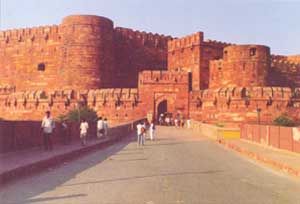
Agra Fort, Agra


Agra Fort, Agra 


Agra Fort represents the first major building project of Akbar, with remains of only a few buildings built by him which now survive. Built on the site of an earlier castle in AD 1565-1575, the fort, apart from other important units, contains Jahangiri Mahal, Khass Mahal, Diwan-i-Khass, Diwan-i-Am, Machchhi Bhawan and Moti Masjid. Many extant buildings were erected by Shah Jahan (AD 1630-1655). Of its four gates, the most impressive is the Delhi Gate on the west.
A little over 1 km from the Taj, on the same river bank, stands the majestic Agra Fort. Though its history dates from as early as 2500 years, it was only during the reign of Emperor Akbar that the city of Agra reached its apotheosis of glory. During his reign, the main part of the Agra fort was built. Construction of the fort started in 1156 and was finished in 1605. Most of the buildings inside the fortress were erected by Shahjahan.

Timings: 6.00 a.m - 5.30 p.m
Open on all days

Monday, 22 October 2012

National Mall & Memorial Parks, Washington, D.C., USA


National Mall & Memorial Parks 


This is the Official National Park Service app for the National Mall and Memorial Parks sites. On your next visit to Washington, D.C., use it to explore many of the most cherished cultural and historical sites in the United States—from the Lincoln Memorial to the White House
Overview - National Mall and Memorial Parks App Overview Page. From which you can access all the various App Features.
Events and News – Get up-to-date information from the National Park Service about what is happening at the National Mall and Memorial Parks sites.
Map – Official National Park Service map of the central tourist area in Washington, D.C. Easy to use while outdoors, the map features large font sizes, walkways that are easily distinguishable from roads, and three zoom levels. By tapping the “Locate me” icon you will always know where you are.
Walking directions – Get from one place to another by following a line on the map or a list of directions. Estimated walking times are given.
Park Lens – Find out what is around you with augmented reality. Just hold up your device and look through the activated camera view. Labels will appear identifying all sites on the National Mall.

Sunday, 21 October 2012

HARBOURFRONT CENTRE – TORONTO , CANADA


HARBOURFRONT CENTRE  – TORONTO


The waterfront in Toronto consists of 10 acres of sheer beauty. Here you’ll find an amazing ice skating rink, a large boardwalk, and a number of great ships on display. One such ship, the 1812 War Privateer of the North Atlantic, allows visitors to come on board and look around. Approximately 12 million people visit the waterfront of Toronto annually.
Harbourfront Centre is a key cultural organization on Toronto, Ontario's waterfront, situated at 235 Queen's Quay West. Established as a crown corporation in 1972 by the federal government to create a waterfront park, it became a non-profit organization in 1991. Funding comes from corporate sponsors, government grants, individual donors and entrepreneurial activities. Harbourfront Centre has a seating capacity of 2,000.
Harbourfront Centre works with 450+ community organizations, and hosts more than 4,000 events a year in many disciplines such as theatre, dance, literature, music, film, visual arts and fine craft.[1]
The federal government faced mounting criticism from the City of Toronto due to the amount of money being spent for Montreal on both Expo 67 and the 1976 Summer Olympics. Hence, the city decided that it would build Harbourfront Centre and the province would build nearby Ontario Place in order to revitalize Toronto's industrial harbour and increase tourism to the city with help from the federal government. As a result, The federal government committed to buying 100 hectares of land to be appropriated for public use. In 1972 "Harbourfront Corporation" was established as a federal Crown Corporation.
Harbourfront Centre was formed on January 1, 1991 as a non-profit charitable organization with a mandate to organize and present public events and to operate a 10-acre (40,000 m2) site encompassing York Quay and John Quay (south of Queens Quay West).
In 1982, Queen's Quay Terminal was remodelled by Zeidler Partnership Architects (the same firm that designed the Toronto Eaton Centre). The project transformed the industrial space into a mixed-use building that included shops, restaurants, offices, and exclusive residential condos (it once was the home for Premier Mike Harris).
Since its inception, Harbourfront Centre has been introducing Toronto audiences to artists and art forms that would not normally be seen in commercial venues.