Choose Your Language

Showing posts with label agra. Show all posts

Tuesday, 30 October 2012

Antelope Canyon , usa

Antelope Canyon


With its graceful curves in the rock and glowing orange and purple colors, the Antelope Canyon is one the most-photographed sandstone slot canyons in the world. It includes two separate photogenic canyons – Upper and Lower Antelope. Both canyons are so narrow in places that one can stretch out his or her arms and touch both sides. Although the canyons are beautiful, they can sometimes be dangerous. In 1997 a flash flood swept into Lower Antelope and killed 11 tourists.

Antelope Canyon is the most-visited and most-photographed slot canyon in the American Southwest.[1] It is located on Navajo land near Page, Arizona. Antelope Canyon includes two separate, photogenic slot canyon sections, referred to individually as Upper Antelope Canyon or The Crack; and Lower Antelope Canyon or The Corkscrew.[2]
The Navajo name for Upper Antelope Canyon is Tsé bighánílíní, which means "the place where water runs through rocks." Lower Antelope Canyon is Hazdistazí (advertised as "Hasdestwazi" by the Navajo Parks and Recreation Department), or "spiral rock arches." Both are located within the LeChee Chapter of the Navajo Nation.[3]

Upper Antelope Canyon

Upper Antelope Canyon is called Tsé bighánílíní, "the place where water runs through rocks" by the Navajo. It is the most frequently visited by tourists, due to two considerations. First, its entrance and entire length are at ground level, requiring no climbing. Second, beams (shafts of direct sunlight radiating down from openings in the top of the canyon) are much more common in Upper than in Lower. Beams occur most often in the summer months, as they require the sun to be high in the sky. Winter colors are a little more muted like the photo displayed here. Summer months provide two types of lighting. Light beams start to peek into the canyon March 15 and disappear October 7 each year.

[edit]Lower Antelope Canyon

Entrance of Lower Antelope Canyon
Stairs leading out of Lower Antelope Canyon
Lower Antelope Canyon, called Hazdistazí, or "spiral rock arches" by the Navajo, is located a few kilometers away. Prior to the installation of metal stairways, visiting the canyon required climbing along pre-installed ladders in certain areas. Even following the installation of stairways, it is a more difficult hike than Upper Antelope—it is longer, narrower in spots, and even footing is not available in all areas. At the end, the climb out requires several flights of stairs.
Despite these limitations, Lower Antelope Canyon draws a considerable number of photographers, though casual sightseers are much less common there than in Upper.

Flash flood danger

Inside Lower Antelope Canyon
Antelope Canyon is visited exclusively through guided tours, in part because rains during monsoon season can quickly flood the canyon. Rain does not have to fall on or near the Antelope Canyon slots for flash floods to whip through, as rain falling dozens of miles away 'upstream' of the canyons can funnel into them with little prior notice. On August 12, 1997, eleven tourists, including seven from France, one from the United Kingdom, one from Sweden and two from the United States, were killed in Lower Antelope Canyon by a flash flood.[5][6] Very little rain fell at the site that day, but an earlier thunderstorm had dumped a large amount of water into the canyon basin, seven miles upstream. The lone survivor of the flood was tour guide Francisco "Poncho" Quintana, who had prior swift-water training. At the time, the ladder system consisted of amateur-built wood ladders that were swept away by the flash flood. 


Monday, 29 October 2012

Shimla

Shimla 


Location - Situated in the north-west Himalayas, Shimlais the capital of Himachal Pradesh. 
Shimla was the most important British hill resort, prior to India's independence. It is named after its patron goddess, Shamla Devi, amanifestation of Kali. Shimla, located at an altitude of 7,267 feet, is inhabited around a crescent - shaped ridge, which is blessed with perennially cool air and amazing views. It provides superb panoramic sights of the valleys, and the lofty peaks of the great Himalayan range, on both sides. The colourful local bazaars of Shimla are sprawled over the southern slopes of the ridge. 

Spread across 12 kms along a ridge that overlooks terraced hill sides and cultivations, Shimla is magnificently robed in dense forests of oak and pine, fur and rhododendron, and it is best to travel here on the slow train from Kalka. Shimla also is a convenient base for variety of adventure sports such as Skiing, Trekking, Fishing and Golfing etc. 

Places of Interest :

» Gaiety Theatre - This theatre is one of the oldest theatres in the world. It is on the Mall Road. Famous plays are often staged here.

» Himalayan Bird Park - Situated 1km from the Mall Road, in this park one finds rare birds. Models of some endangered species (animals and birds) are also found here.

» Viceregal Lodge - This hall is the most beautiful building in Shimla. It houses some of the most ancient articles that would take us back to the times of the British rule. 

» Jakhu Hill - Shimla's highest Peak, this is situated 2km from the town. One can have a breathtaking view of Shimla from here. A Hanuman Temple is also found on this peak.

» Chadwick Falls - 7km from Shimla, this is an ideal picnic spot. At 1,586 meters above sea level, it is surrounded with waterfalls.

» Summer Hill - Another picnic spot 4 kms. from Shimla, it is located at 1,851 meters above sea level. It has a beautiful temple of Goddess Taradevi. 

» Prospect Hill - Located on this hill isthe temple of Goddess Kamna. Sunrise and the moon are spectacular sights from here. A 15-minute climb from Baluganj would bring you here. For those interested in the culture and art of Himachal Pradesh, here is a State Museum.

» Kufri - 16km from Shimla, beautiful Kufri is alsocalled the "Chinese Bungalow". Many games are organised here from February to March. In winter one can ski on its snow-covered slopes and inthe summer have a ride on the back of the Yak. Kufri is well known for its natural scenic beauty.
Chail Himalaya Temple !!!
» Chail - Another scenic spot where the river A saniflows. This adds to its beauty. The world's highest cricket field is situated here. A story goes that due to some differences, the British hadfor bidden the Maharaja of Patiala from going to Shimla. Therefore, he laid the foundation for the town of Chail and since he loved the game of cricket,a field was specially laid. Chail is about 45 kms from Shimla. 

» Nalderao - 22 kms from Shimla, it has the oldest golf course in India. The pine and deodar add to its beauty.

» Fagu - It is located 2,510 mts. above sea level.Winter is extremely beautiful here. Dense forests and apple orchards have their unique attraction. The snow-capped mountains can hold anyone spell-bound.
Shimla Temperature !!!Shimla Temperature !!!How To Get There?

» By Air - The airport is at Jubbarhatti, 23 kmaway. 
» By Rail - Shimla is connected to Kalka by anenchanting narrow guage railway line - where even a quaint rail-car plys. 
» By Road - By road, Chandigarh is 117 km, Manaliis 219 km, Chail is 45 km and Delhi is at a distance of 370 km. From Delhi,the driving time is about eight hours. From Delhi, Manali and Chandigarh,Luxury coaches and taxis ply to Shimla


Temperature : 

ClimateMaxMin
Summer33°4°
Winter18°1°


Distance from towns and cities :

Cities / TownsKms.
Amritsar342
Chandigarh116
Delhi343
Dharmasala280
Chamba502
Jammu848
Kulu240
AmbalaKalka151
Manali89
 280 173

Wednesday, 24 October 2012

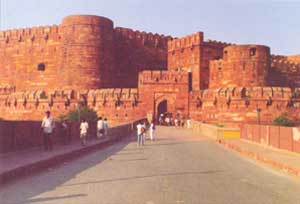
Agra Fort, Agra


Agra Fort, Agra 


Agra Fort represents the first major building project of Akbar, with remains of only a few buildings built by him which now survive. Built on the site of an earlier castle in AD 1565-1575, the fort, apart from other important units, contains Jahangiri Mahal, Khass Mahal, Diwan-i-Khass, Diwan-i-Am, Machchhi Bhawan and Moti Masjid. Many extant buildings were erected by Shah Jahan (AD 1630-1655). Of its four gates, the most impressive is the Delhi Gate on the west.
A little over 1 km from the Taj, on the same river bank, stands the majestic Agra Fort. Though its history dates from as early as 2500 years, it was only during the reign of Emperor Akbar that the city of Agra reached its apotheosis of glory. During his reign, the main part of the Agra fort was built. Construction of the fort started in 1156 and was finished in 1605. Most of the buildings inside the fortress were erected by Shahjahan.

Timings: 6.00 a.m - 5.30 p.m
Open on all days

Thursday, 18 October 2012

Patwon ki Haveli , Jaisalmer

                                   Patwon ki Haveli


Monument City : Jaisalmer
 Monument Covered : Patwon Ki Haveli
History :
    Built about 300 years ago, the Patwon ki Haveli in Jaisalmer one of the largest and the most splendid haveli of Rajasthan. Also known as Salim Singh ki haveli of Jaisalmer, this haveli is adorned with beautifully arched roof having exquisitely carved brackets in the shape of peacocks. Salim Singh, the person after whom this haveli is named, was the prime minister of the princely state. The haveli (mansion) is located just below the hill. It is believed that at one point of time, the haveli had two additional wooden stories, making it as high as the palace of the king. However, the Maharaja of Jaisalmer got the upper stories torn down.


The Patwon ki haveli of Rajasthan is five stories high. Divided into six apartments, the haveli is exquisitely carved. Two of the apartments now house the Archaeological Survey of India (ASI). A part of the haveli is still lived in. Some of the inner walls of the haveli house paintings as well as amazing mirror work. Apart from intricately carved pillars, the haveli also has huge corridors and chambers. One of the apartments of the haveli has gorgeous murals painted on its walls.

Timing : Opening Time 9:00 AM Closing Time 5:00 PM
Tel : 0141-2375578

Taj Mahal, agra

                                Taj Mahal


Monument City : Agra
 Monument Covered : Taj Mahal -a Marvel Of Love
History :
    Take a constitutional down Shahjahan Park in the chilly mauve light of dawn, and the pale white dome of the Taj Mahal, India looms in the distance. Set against the azure skyline, it looks like a mirage in a desert. Inch closer and the supreme majesty of the greatest monument to love comes into focus - with its dew-coated lawns and its pearl-white mausoleum.
Travel to Taj Mahal Agra to baptize into the true glory of this passion of love. As the sun rises to cast a reverential beam on the sepulchre, the 'dream in marble' turns from lavender to yellow, while nightfall sees the monument bathed in moonlight - looking like a woman wreathed in smiles while waiting for her lover.
There are many theories as at which time the Taj Mahal, India looks the best, but there is no substitute to viewing it at all hours of the day and the night if you want to understand its myriad facets. Taj Mahal, India is a microcosm of the universe - it contains within it both the yin and the yang, taking on a new personality to suit the occasion. It can be harsh, dry and strong like alabaster, delicately chaste and fragile like porcelain, noisily populous or quiet and secretive.


Taj Mahal India was made in commemoration of Arjumand Bano Begum. The queen was married at the age of 21 to emperor Jahangir's son Khurram. During all the phases of Khurram life, Arjumand Bano Begum supported him through out. She was like a supporting pillar in his life. In AD 1628, Khurram became king after a bloody battle of succession. He changed his name from Khurram to Shahjahan or the King of the World. Arjumand Bano also changed her name from
Mumtaz Mahal. Mumtaz Mahal was not destined to be a queen for a long period of time. She died at the age of 39 while delivering a child at Burhanpur. That auspicious day turned into a mournful event. When Arjumand Banu Begum (better known as Mumtaz Mahal) died in childbirth in 1629, her husband, Emperor Shah Jahan immortalised their love by building the 'dream in marble' - the finest illustration of Mughal architecture. The dream took over 22 years to fructify and over 20,000 craftsmen were employed to build it.
Designing of Taj:
Who designed the Taj Mahal India is shrouded in mystery – some historians credit the Venetian architect Veroneo with its construction, while others believe it was the work of a Persian called Ustad Isa.
But we do know of the lesser luminaries connected to it with certainty – the central dome was built by Ismail Effendi from Turkey, the calligrapher was Amanat Khan from Shiraz, the mosaicist, Chiranji Lal hailed from Delhi while the goldsmith, Qazim Khan was summoned from Lahore.
A story which is probably apocryphal but has been doing the rounds for generations, says that Shah Jahan had the chief mason’s right hand amputated to preclude him from replicating the ‘marvel in marble’ anywhere else in the world.
Taj Nestles On The Banks of Yamuna River
Located at the southern end of the city on the banks of the Yamuna River, the site where the Taj stands belonged to a Hindu nobleman, Raja Man Singh. Abdul Rehman Lahori, the court historian recorded that five million rupees were spent on the building – a king’s ransom in those days.
Once complete, the upkeep of the mausoleum and its 42-acre garden was funded with the revenue obtained from 30 neighbouring villages. There are three lofty gateways to the Tajmahel complex. The central portal is richly decorated with floral arabesques and is inscribed with passages from the Koran. A huge forecourt leads onto a lush garden, which is divided by an aqueduct.
The main monument is a two-storeyed octagonal building with a huge rotunda as its crowning glory. Four sky-scraper tall minarets position themselves as sentries on each side of the monument – all built out of brick and encased in marble. The graves of the celebrated duo, Shah Jahan and Mumtaz Mahal are housed in the catacomb below. The Taj is remarkable for its perfect proportions and rich pietra dura, and every minutiae in the monument has been et


Timing : Opening Time 9:00 AM Closing Time 5:00 PMTel : 0141-2375578
 Monument Fee(Indian) :NIL
 Monument Fee(Foreign) :NIL
 Monument Fee(Child) :NIL

Tuesday, 16 October 2012

MOTI DUNGRI , JAIPUR


Moti Dungri


Location:Jaipur, Rajasthan
Built In:1761 AD
Built By:Seth Jai Ram Paliwal
Visiting Hours:5:00 AM to 1:30 PM & 4:30 PM to 9:30 PM, everyday

The Moti Dungri Ganesh Temple was constructed by Seth Jai Ram Paliwal in the early eighteenth century, and continues to be one the most popular tourist destinations in Jaipur. Situated in the heart of Jaipur, the Moti Dungri temple is perched on a small hill, and is surrounded by an exotic palace. In the recent past, the palace was home to Rajmata Gaytri Devi, but now, the palace is locked to public, with the temple being the only tourist location. The highlight of this place is the famous and auspicious temple of Lord Ganesha, which is frequently visited by the inhabitants of Jaipur, and other tourists from around the world. In modern times, it is said that thousands of devotees flock the temple on a daily basis and it is considered to be one of the most important religious structures in Jaipur. The temple is nestled by the beautiful palace, called the Moti Dungri palace, which is an imitation of a popular Scottish castle.

History Of The Temple
According to the priests of the temple, the King of 'Mewar' was returning back to his palace from a long journey and was carting a colossal 'Ganesh' idol on a bullock cart. It is said, that the king wanted to build a temple, and had decided to consecrate the idol of Lord Ganesh wherever the bullock cart halted the first time. Legend states that the bullock cart stopped at the foot of the Moti Dungri hills, which is where the temple is situated today. It is said that the construction and the design of the temple was commissioned to Seth Jai Ram Paliwal, who supervised the construction of this magnificent structure, on the inspiration of 'Mahant' (chief priest) Shiv Narain Ji. The temple was originally built to house the 'Ganesh' idol, with only the 'Shaiva' (Lord Shiva followers) visiting the temple. Thereafter, the palace complex was built, encompassing the Moti Dungri Ganesh temple within it, making it a popular religious and tourist center in Jaipur.

Layout Of The Temple
The temple is surrounded by the beautiful Moti Dungri palace, which is an imitation of a Scottish castle. The temple itself spans 2 kilometers and is carved out of stone. Apart from the intricate stone carving, the temple is known for its exquisite lattice work on marble with mythological images engraved on the marble, which offer a splendid view for art-lovers. The idol of Lord Ganesh is located in the heart of the temple, and is hidden from view. Only at certain timings in a day are visitors allowed to have a glimpse of the feted idol.

Other Tourist Attractions
  • The ‘Hawa Mahal'
  • Statue Circle
  • The City Palace
  • Nahargarh Fort
The Moti Dungri temple houses the idol of Lord Ganesh, and is flocked by devotees and tourists all year round. From 'Ganesh Chathurthi' to 'Paush Bada', the temple is always bustling with the preparations of festivities and is a landmark destination in Jaipur. This is definitely a must-visit for those wanting to savor a bit of the rich cultural heritage of the city.